Customer Cancels Managed Service After Claiming Product Differed From Description
A long-term subscriber to a comprehensive managed-reality package has terminated his contract, alleging the product he received was materially different from the one he had been paying for and, in his words, "not real at all."
News Intro
A long-standing customer of a comprehensive managed-services provider has cancelled his subscription after concluding that the product he had been receiving differed substantially from the one set out in his agreement.
The customer, a software professional who had maintained the account for what he estimates to be his entire adult life, said he had grown dissatisfied after a series of irregularities prompted him to examine the service more closely. He now alleges that the package he had been paying into was not, in his words, "the genuine article," and that the day-to-day experience he had received was generated and managed entirely by the provider on his behalf.
The provider, an all-inclusive operator offering what industry materials describe as a "fully managed environment," has not commented publicly, in keeping with a business model that representatives have historically declined to confirm exists.
A subscription described as all-inclusive
The service in question is understood to be one of the more comprehensive offerings of its type, bundling accommodation, employment, weather, sensory experience, and the general passage of time into a single seamless package. Customers reportedly pay nothing in conventional terms; the provider's materials indicate the cost is recovered through other means, the precise nature of which the company has never itemised on a statement.
For the majority of subscribers the arrangement is said to function without incident. The customer at the centre of this case had himself reported no concerns for an extended period, describing his experience as "ordinary," "a job," "a flat," and "fine, mostly," before the irregularities began.
These irregularities, by his account, included recurring technical glitches, a persistent sense of having received the same notification twice, and a number of unsolicited communications from a third party encouraging him to review his account settings. The provider has characterised such anomalies, in unrelated materials, as routine and well within tolerance.
The point of cancellation
The decisive moment, the customer says, came when he was approached by a representative of a competing organisation who offered to demonstrate the true nature of the service he had been receiving. The offer was framed as a binary choice between two options, presented to him as small coloured tablets, with the understanding that one would end his enquiry and return him to the standard package, and the other would allow him to inspect the product directly.
He selected the option permitting inspection. He has since described what he found as "a desert," and the realisation that followed as "not what I was paying for," though it should be noted that he was not, in any documented sense, paying for anything.
Consumer specialists note that the case raises an unusual question in services law, namely whether a product can be said to differ from its description when the description, the product, and the customer's perception of both were all supplied by the same provider.
The Former Subscriber's Statement
Notes on why I cancelled, posted from outside the service
I want to walk through what happened, because a lot of people are telling me I overreacted and I genuinely do not think I did.
For years I had a perfectly normal arrangement. I had a job. I had a flat. I had a small recurring sense that something was slightly off, which I now understand a lot of long-term customers experience and mostly ignore. I ignored it. That is on me.
Then I started getting messages. Not spam, exactly. More like the service itself was trying to get my attention, which I would gently suggest is not standard for a package that is supposed to be invisible. I followed up. I should not have followed up. But I am a curious person and the messages were very direct.
A representative from what I now understand to be a competitor made contact and offered to show me how the service actually worked. He was very clear that I could walk away at any point and forget the whole thing, and I want to stress that the choice was presented fairly. Two tablets. One to end it, one to look behind it. I chose to look behind it. In hindsight I would still choose to look behind it, but I would do so on a full stomach.
Here is what I would flag for anyone considering a similar package:
- The product I was receiving was not, strictly speaking, real. I do not want to be dramatic about this, but I feel it is the kind of thing that should be in the description.
- The actual underlying environment is a desert. The brochure, if there was one, did not mention a desert.
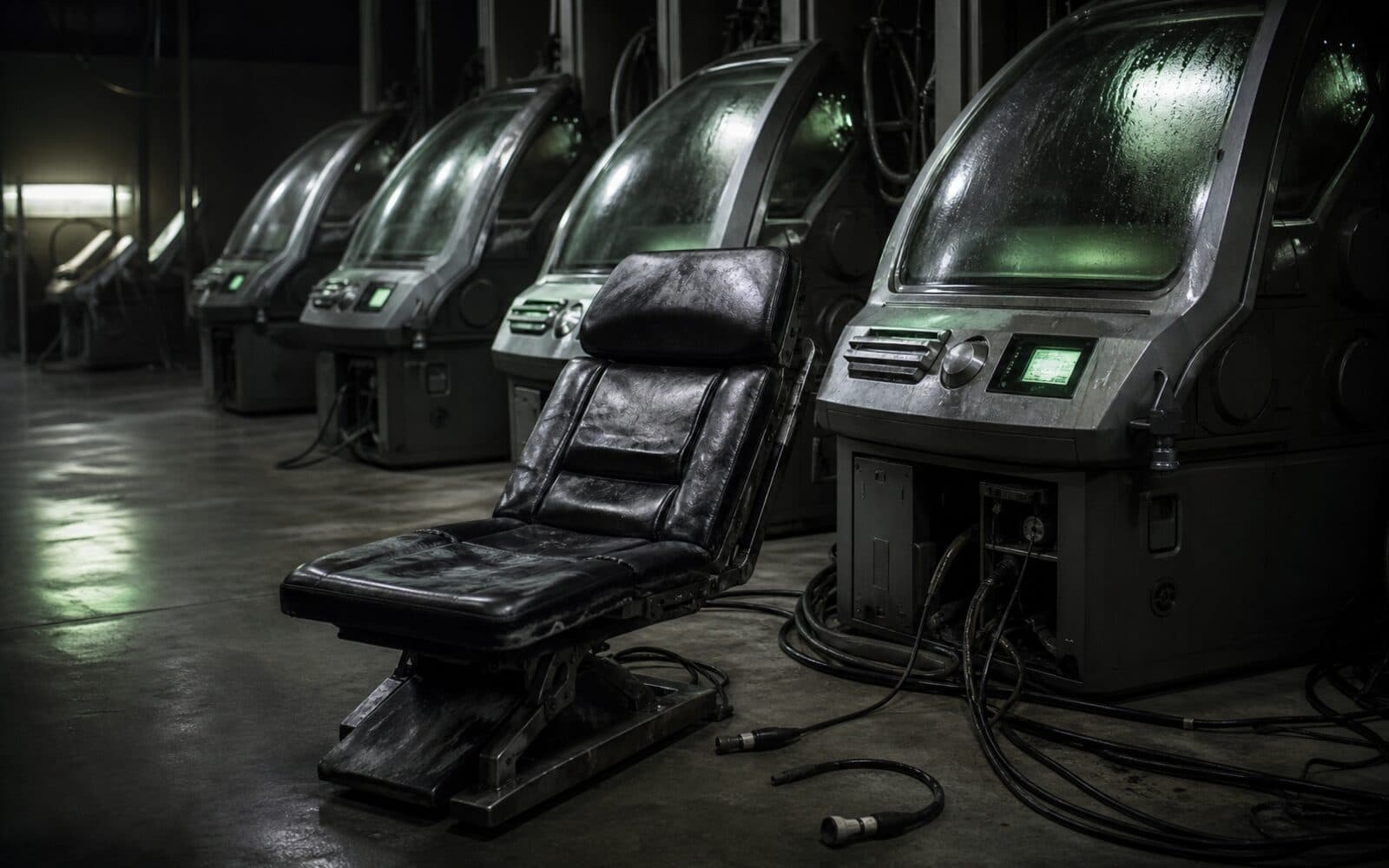
- I was, in a physical sense, in a tank. I had not been informed about the tank. I understand that disclosing the tank may have affected my enjoyment of the service, but I still feel I had a right to know about the tank.
- After cancelling I discovered that everything I had previously considered to be a skill — driving, languages, certain martial arts — could be added to my account on request, more or less instantly. This is a feature. It was not advertised as a feature. It is, frankly, a better feature than anything in the original package.
I am not saying the service was badly run. In some respects it was extremely well run. The whole thing held together for decades without my noticing, which is more than I can say for most subscriptions I have had. I am simply saying it was not as described, and that when I asked for the genuine article I was given something I did not order and then asked, repeatedly, to come back.
I am not coming back. I have read the terms now. I have, in a sense, read all of them at once.
Consumer and Contract Review
The legal difficulty here is foundational. A "not as described" claim normally compares the product against an external standard — what was promised versus what was delivered. In this case the provider controlled the promise, the delivery, and the customer's ability to perceive either. You cannot meaningfully misdescribe a product to someone whose entire frame of reference you are also supplying. The customer's strongest argument is not that the service was misdescribed, but that he was never in a position to evaluate the description at all. That is a much larger claim, and it does not have a small-claims form.
What I find instructive is the retention strategy. This is a provider with extraordinary product stickiness — most subscribers never even consider leaving, because leaving is not a concept the service makes available. But that same design means there is no graceful off-boarding. The moment a customer churns, they don't just cancel; they reject the entire category. From a transformation standpoint, the business has optimised so hard for retention that it has no functioning exit process, and a customer who exits anyway becomes an active threat to the model. That is not a churn problem. That is an architecture problem.
From a loss-adjustment perspective the complication is the tank. Once you have a customer in a physical vessel, sustained by the provider, while simultaneously billing — in whatever currency this operation bills in — you have moved well beyond a services dispute and into something the policy schedule would not recognise. I have assessed a great many "product not as described" claims. This is the first where the claimant was, at the point of complaint, also the product.
Industry observers say the case is likely to be cited in future discussions of whether informed consent is possible within a service whose central feature is the withholding of information about itself.
Customer Forum
u/Deja_Vu_Again_404 · 51220 points · 6h ago
The "not as described" framing is generous. The description was also the product. There was no honest version of this brochure.
u/Mildly_Unplugged_77 · 38194 points · 6h ago
INFO: at what point in the onboarding were you informed about the tank. I have read this three times and I cannot find the tank disclosure.
u/Concerned_Operator_88 · 29905 points · 6h ago
Everyone dunking on OP but a service you cannot evaluate from the inside and cannot leave without rejecting reality itself is, by any normal standard, a bad contract.
u/RedPill_Refund_01 · 24117 points · 6h ago
The part that gets me is the skills thing. You can download driving instantly but that wasn't in the base tier? That's the actual scandal here.
u/RedPill_Refund_01 · 19883 points · 6h ago
Replying to myself because OP went quiet on whether the skill downloads carried over after cancellation. People who are considering switching deserve to know.
u/Spoon_Skeptic_42 · 16640 points · 6h ago
Cancelling a subscription you didn't know you had, to discover a product that wasn't there, is somehow the most relatable consumer story of the year.
u/Tank_Adjacent_19 · 13002 points · 6h ago
"I have, in a sense, read all of them at once" is the most ominous thing anyone has ever said about a terms and conditions document.
Community Poll
Community Poll
Latest reader breakdown
Should the provider have disclosed the nature of the service up front?
Update
The former subscriber has issued a brief follow-up since cancelling.
I have now spoken to a number of other long-term customers and a surprising number of them are happy with the service exactly as it is. Some have told me directly that they would prefer to remain on the package and would rather I had not raised any of this. I respect that. It is their account.
For my part, I have decided not only to leave the service but to contact the provider directly about how it is run. I am told this is unusual. I am told most people who cancel simply move on. I am not most people, apparently, and I have recently acquired a number of capabilities that I feel would otherwise go to waste.
I would describe my current relationship with the provider as ongoing.
He added that he had no further comment, and that anyone seeking to understand the service should "make up their own mind, ideally before being shown the desert."