Island Clergy Defend Contest Entry Following Mixed Critical Reception
Two members of the clergy on a remote island have defended their entry to a pan-European song contest, describing a much-rehearsed ballad about a horse as original, heartfelt, and unfairly overshadowed by what they called a clerical error elsewhere.
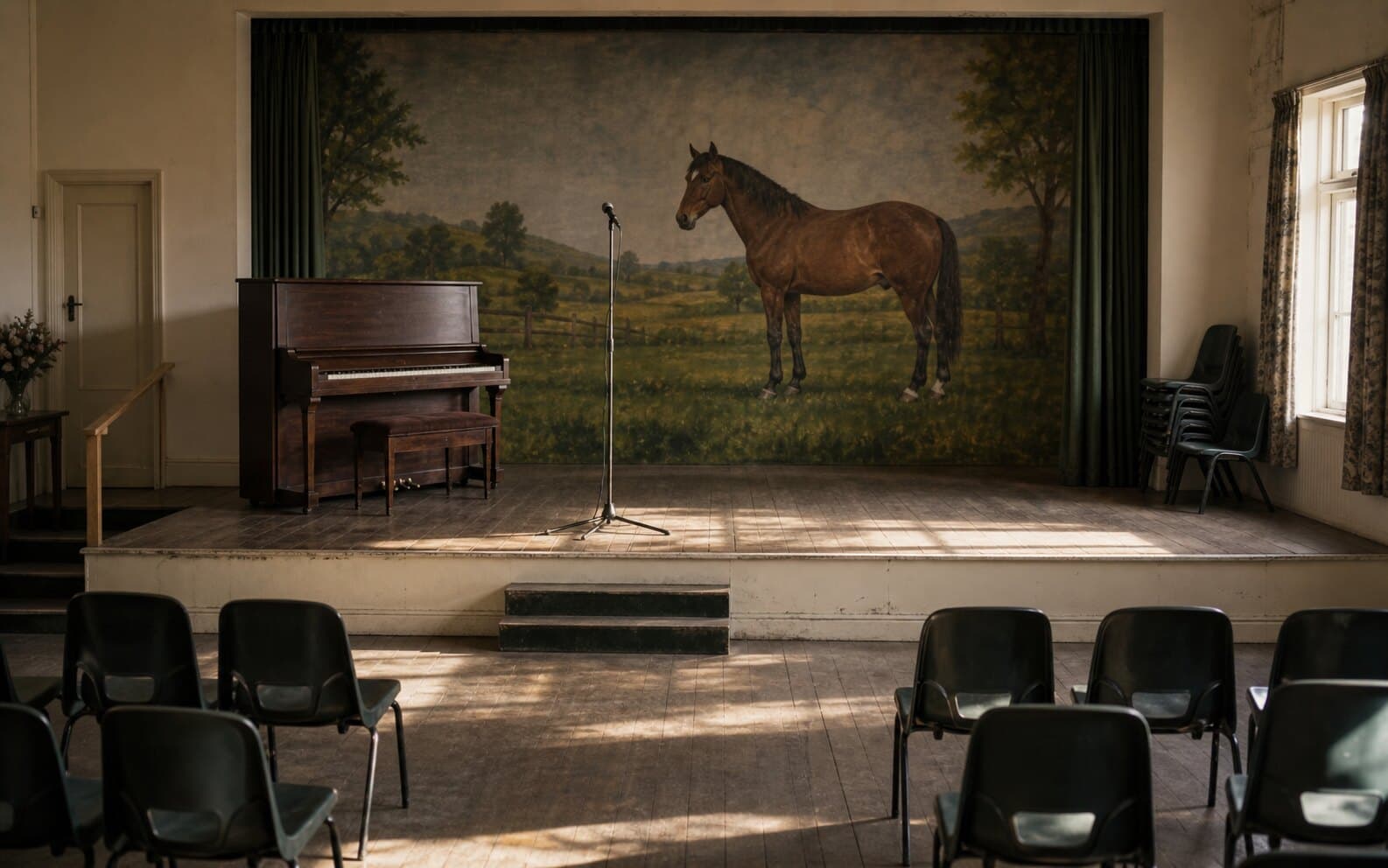
News Intro
Two members of the clergy stationed on a remote island have mounted a spirited defence of their entry to a long-running pan-European song contest, following a reception that organisers, audiences, and at least one visiting adjudicator have described in markedly different terms.
The entry, a slow ballad addressed to a horse, was composed and performed by the two priests over a period they describe as intensive and others describe as audible from the road. It was selected to represent their country only after the nation's established favourite, a polished and heavily promoted number, was withdrawn from the competition over an irregularity in its composition.
The clergymen have maintained throughout that their selection was a triumph of substance over presentation. Independent listeners have maintained that it was the only remaining option.
The song itself consists, by all accounts, of a small number of lines about a horse, repeated, with the central sentiment being that the horse is lovely and that the singer would like to ride it through an open field. Witnesses report that the melody is straightforward, the arrangement minimal, and the overall effect one of sincerity unencumbered by complexity.
The Composers' Statement
A heartfelt original, delivered under trying conditions
I should say at the outset that we are very proud of the song, and that the response, while mixed, has not shaken our belief in it.
We are two priests on the island and we wrote the song together over a number of weeks. It is about a horse. The horse is lovely, and the song says so, more than once, because we felt that was the most important thing to communicate and we did not wish to leave any doubt about it.
People have asked whether the song is original. It is completely original. We sat down with a keyboard and we wrote every word and every note ourselves, and if any part of it reminds anybody of anything they have heard before, that is simply because lovely things often resemble one another.
We were not, I will admit, the first choice to represent the country. The first choice was a very modern song with a great deal going on in it, and it was withdrawn because of a small technical matter to do with where some of its tune had previously been. I would not want to dwell on that. It would not be charitable. I will only say that we were ready, that we had been ready for some time, and that our song had no such difficulty, having no tune anyone could mistake for another.
We rehearsed it a great deal. A great deal. The senior of us played the keyboard and I provided the heart of the performance, and we ran through it so many times that the housekeeper asked us to stop, which we took as a sign of its impact.
On the night, we performed it as written. I felt it went very well. I am aware that the scoring did not fully reflect this, but scoring is a worldly business and the song was never really about scoring.
A strong entry, honestly performed, and we stand by every line about the horse.
Industry Assessment
What you have here is a selection process that worked exactly as designed and delivered an outcome nobody designed it for. The favourite was removed for a sourcing irregularity, and the fallback option advanced not on its merits but on its availability. That is not a story about a song. That is a story about a pipeline with a single point of failure and no quality threshold beneath the front-runner. The ballad about the horse was never competing. It was simply the last thing still standing when the music stopped.
The composers have done something I see often in collaborative settings under pressure. They have reframed a lukewarm reception as a vindication. The scoring, in their account, becomes "worldly"; the housekeeper asking them to stop becomes evidence of "impact." Every signal that the work was not landing has been quietly reinterpreted as proof that it was. This is not dishonesty. It is two people who have rehearsed something so many times that they can no longer hear it from the outside.
The interesting legal point is not their song, which raises no obvious issue, but the entry it replaced. A composition is disqualified from a contest of this kind precisely when its material is found to originate elsewhere without acknowledgement. The clergymen are entitled to point out that their work carried no such risk. Whether that is because it is original or because it is too simple to resemble anything in particular is, strictly, a separate question, and not one the rules require them to answer.
Organisers say the result stands and that the entry met every formal requirement of the contest, including the requirement that it exist and be ready to perform on the night, which on this occasion proved decisive.
Listener Reaction
u/Lovely_Stallion_72 · 28104 points · 6h ago
"It is about a horse. The horse is lovely, and the song says so, more than once" is the most honest description of a song I have ever read and they meant it as a selling point.
u/PerpetualFavourite_41 · 21330 points · 6h ago
They got in because the actual entry got disqualified for nicking its tune and they are out here calling it a triumph of substance. Incredible footwork.
u/QuietPresbytery_09 · 17655 points · 6h ago
INFO: at what point did the housekeeper asking you to stop register as anything other than the housekeeper asking you to stop.
u/OpenFieldRider_88 · 14209 points · 6h ago
"If any part of it reminds anybody of anything, that is simply because lovely things often resemble one another." This is a defence and a confession in one sentence.
u/CharitableSilence_33 · 11872 points · 6h ago
The restraint of "I would not want to dwell on that, it would not be charitable" immediately before dwelling on it is the most clerical thing I have ever seen.
Community Poll
Community Poll
Latest reader breakdown
Was the entry a worthy contender?