Operator Praises Uninterrupted Service Despite Vehicle Unable To Reduce Speed
A city transit provider has highlighted a service that maintained continuous forward motion throughout an entire route, while declining to dwell on the fact that the vehicle in question was at no point able to slow down.
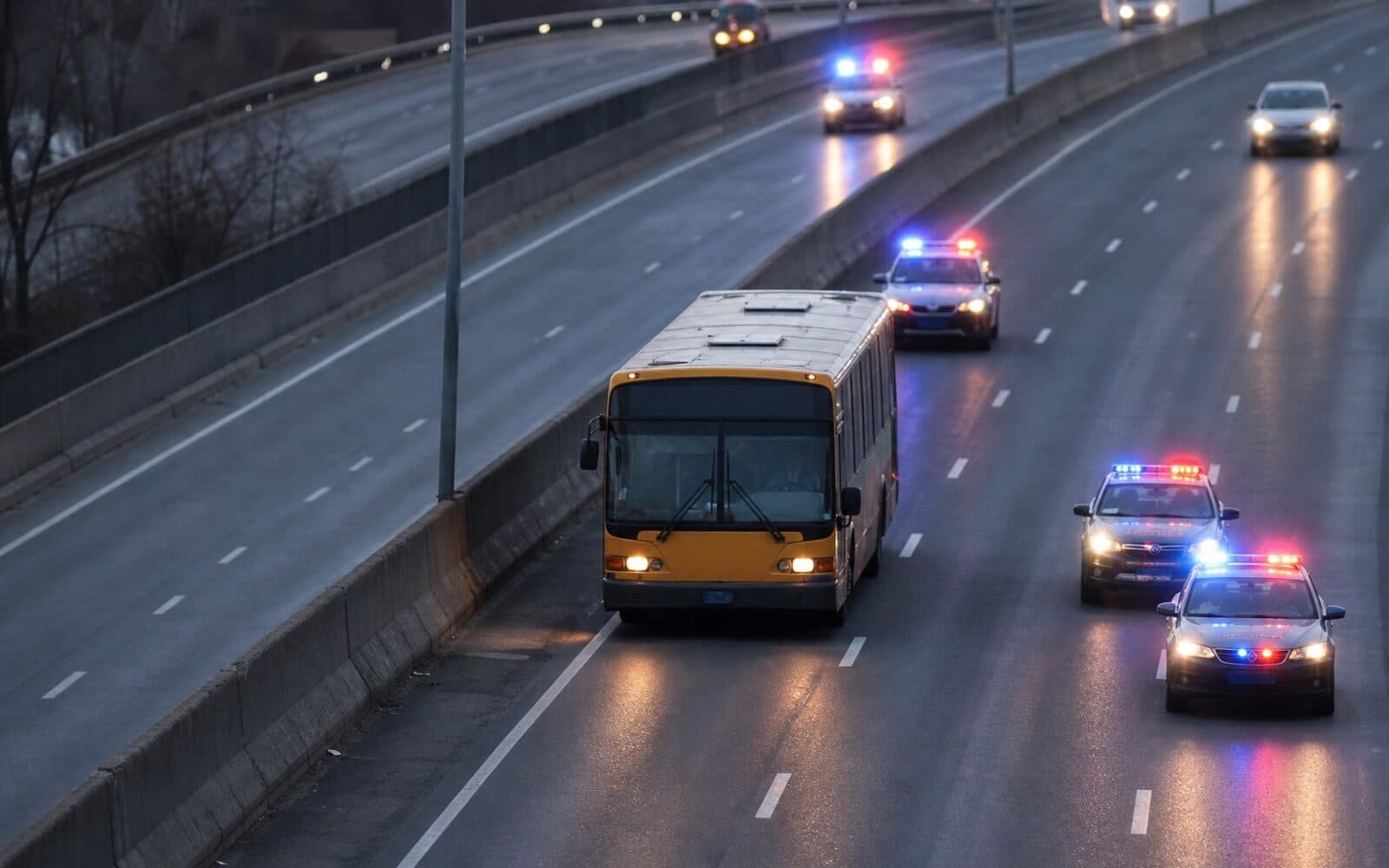
News Intro
A metropolitan transit operator has issued a statement praising the punctuality and uninterrupted nature of one of its services, after a scheduled bus completed a lengthy journey across the city without a single stop, a delay, or a moment of reduced speed.
The vehicle is understood to have departed on a routine morning service before a device was attached to it that triggered acceleration past a fixed threshold. According to officials briefed on the matter, the bus was thereafter unable to drop below a set speed without consequences that have not been described in full to passengers.
The service did not call at its advertised stops. Passengers were unable to board or alight in the conventional manner. One transport authority described the resulting experience as "continuous," a characterisation that has not been disputed by anyone aboard.
The route taken was not the route printed on the front of the vehicle. It is understood to have included a section of unfinished elevated motorway, a gap in that motorway, and a return to surface roads. The operator has confirmed that headway between this service and the one behind it was, throughout, considerable.
A spokesperson noted that the vehicle maintained its average speed "comfortably above target for the entire duration of the route," and that at no point did it idle, queue, or wait at a signal. The statement did not address whether it could have done so had it wished.
The journey concluded when passengers were transferred to an alternative mode of transport. The bus itself continued unaccompanied for a short further distance.
A service that could not stop
I have worked in passenger transport for a long time, and I am not often able to point to a service that ran exactly as a service should: continuously, without interruption, and at a healthy clip. This was one of those days.
Let me address the speed first, because people keep raising it. Yes, the vehicle was required to maintain a minimum velocity. I would gently point out that most complaints we receive are about buses being too slow. On this occasion that was not a problem we had.
The service did not stop. I understand some passengers had places to be. So did the bus. It simply went there at pace, and kept going, which is more than can be said for a lot of the network on a wet Tuesday.
There has been some focus on the fact that boarding and alighting were not possible during the service. I would frame that differently. There were no missed stops, because there were no stops. You cannot fall behind a timetable you have left entirely. From a reliability standpoint, this is close to ideal.
Regarding the section of road that was not finished: the gap was bridged, the service continued on the far side, and the journey was not abandoned. I think that reflects well on the driver, who I am told was a member of the public stepping in, and who I would describe as having shown excellent customer focus under conditions our training does not currently cover.
The vehicle was eventually emptied of passengers in an orderly fashion while still in motion, which is unusual, and which we are reviewing. After that the vehicle continued on its own. It did not, at any point, terminate early.
We have logged the journey as completed.
Punctuality without choice
The operator keeps returning to the idea that a service which cannot stop is a service which is never late. That reframing is doing an enormous amount of work. What's striking is the genuine pride in the language. There is no acknowledgement that the passengers were not customers in any ordinary sense, but people who could not get off. Reliability is being measured against a target that no longer maps to what anyone aboard actually wanted.
On paper this is a vehicle that suffered no breakdown, no collision at terminus, and no idle time, which are normally three things we are delighted to see. The difficulty is that the reason for all three is the same single device, and that device is the entire claim. I assessed the road gap separately. I would prefer not to discuss the road gap.
Transport analysts have noted that the operator's performance metrics, taken in isolation, are among the strongest the network has recorded, and that this is precisely the problem.
The network view
What nobody is examining is the headway. A vehicle unable to reduce speed creates an obvious block-section conflict with any service ahead of it on the same alignment. On the railway this would be a catastrophic signalling failure, and the bus's apparent ability to maintain spacing without braking suggests the rest of the route was simply cleared ahead of it, which raises far more questions about line capacity than anyone is asking.
The interesting question is contractual. A passenger boards under an implied term that they may, at a stop of their choosing, get off. Here that term was suspended mid-journey by a third party. Whether the operator can claim a service was "delivered" when the defining feature of the service was the impossibility of leaving it is, I would say, genuinely untested.
From the moving carriage
u/Minimum_Velocity_50 · 41277 points · 6h ago
"You cannot fall behind a timetable you have left entirely" is the most unhinged customer service line I have ever read and I will be using it at work.
u/MindTheGap_215 · 33910 points · 6h ago
There was an UNFINISHED MOTORWAY. With a GAP. And the takeaway is "the journey was not abandoned." Sir there was a hole in the road.
u/Standee_At_The_Back_19 · 20188 points · 6h ago
Boarding and alighting "not possible during the service" is one way to describe being unable to leave a moving bus.
u/PunctualToAFault_77 · 14502 points · 6h ago
Genuinely the most reliable bus I have ever been on and I am not allowed to be happy about it.
u/FareEvader_Innocent · 233 points · 6h ago
Honestly didn't pay for the full route and at no point felt I owed them for it.
u/Replacement_Service_88 · 119 points · 6h ago
The "alternative mode of transport" doing a lot of work there. They mean the train. It was a train.
Where the service terminated
A short follow-up, as several people asked what became of the vehicle.
The bus completed its unaccompanied final leg and is no longer in service. I want to be measured here: it did not return to the depot. The matter is with our fleet team.
I have seen the comments about the device. I would only say that for the duration it was attached, our average speed compliance was the best in the region. We are not going to retrofit the device. That has been asked several times.
The replacement service ran on rails. I have nothing further to add about the rails.